|
| |
| |
| |
| | |
HOʻOKIPA
Welcome
Aloha kākou,
I am writing to you today from Molokaʻi, where I have returned with our ʻohana to the island that has played such an important part in my own learning and the lineage I carry.
Being here brings certain understandings into focus.
When we speak of Hawaiian spirituality, we are not speaking simply about a collection of beliefs, ceremonies, or practices that can be separated from the world in which they developed. We are speaking about a way of understanding existence in which humanity was never alone.
The ocean, the winds, the mountains, the rains, the forests, the stars, and the generations of people who came before us were not understood as unrelated parts of life.
They belonged to a world of relationships.
Within that world were the akua, the ʻaumākua, and the poʻe kahiko.
These are three distinct dimensions of Hawaiian ancestral understanding. Each carries its own nature, history, responsibilities, and relationships with humanity.
Yet today, these distinctions are often poorly understood.
Akua are reduced to characters in mythology. ʻAumākua are described simply as spirit animals or personal protectors. Ancestors are remembered primarily as people who lived before us, rather than recognised through the continuing relationships and responsibilities carried between generations.
Something important is lost when these understandings are reduced in this way.
And it is precisely this that I want to explore with you in November. |
| | | |
| | |
HE LEO NO NĀ KŪPUNA
A Message from the Ancestors
The World Was Never Empty
Our kūpuna inherited a world already filled with life, presence, power, and relationship.
The akua were understood through the great powers and processes of existence. Kāne, Kanaloa, Kū, Lono, Pele, Hiʻiaka and many others belonged to a complex world of genealogies, stories, responsibilities, and relationships.
The ʻaumākua carried another dimension. They were connected to particular families and ancestral lines, with relationships that involved care, guidance, protection, recognition, and responsibility.
And the poʻe kahiko were those who had lived before us, whose knowledge, choices, practices, and experiences became part of what succeeding generations inherited.
These distinctions matter.
To understand an akua is not the same as understanding an ʻaumākua. To honour an ancestor is not necessarily the same as recognising an ancestral guardian. And to know the names of these beings is not the same as understanding the relationships and responsibilities through which they were approached.
We cannot understand Hawaiian spirituality deeply while leaving these foundations unexplored.
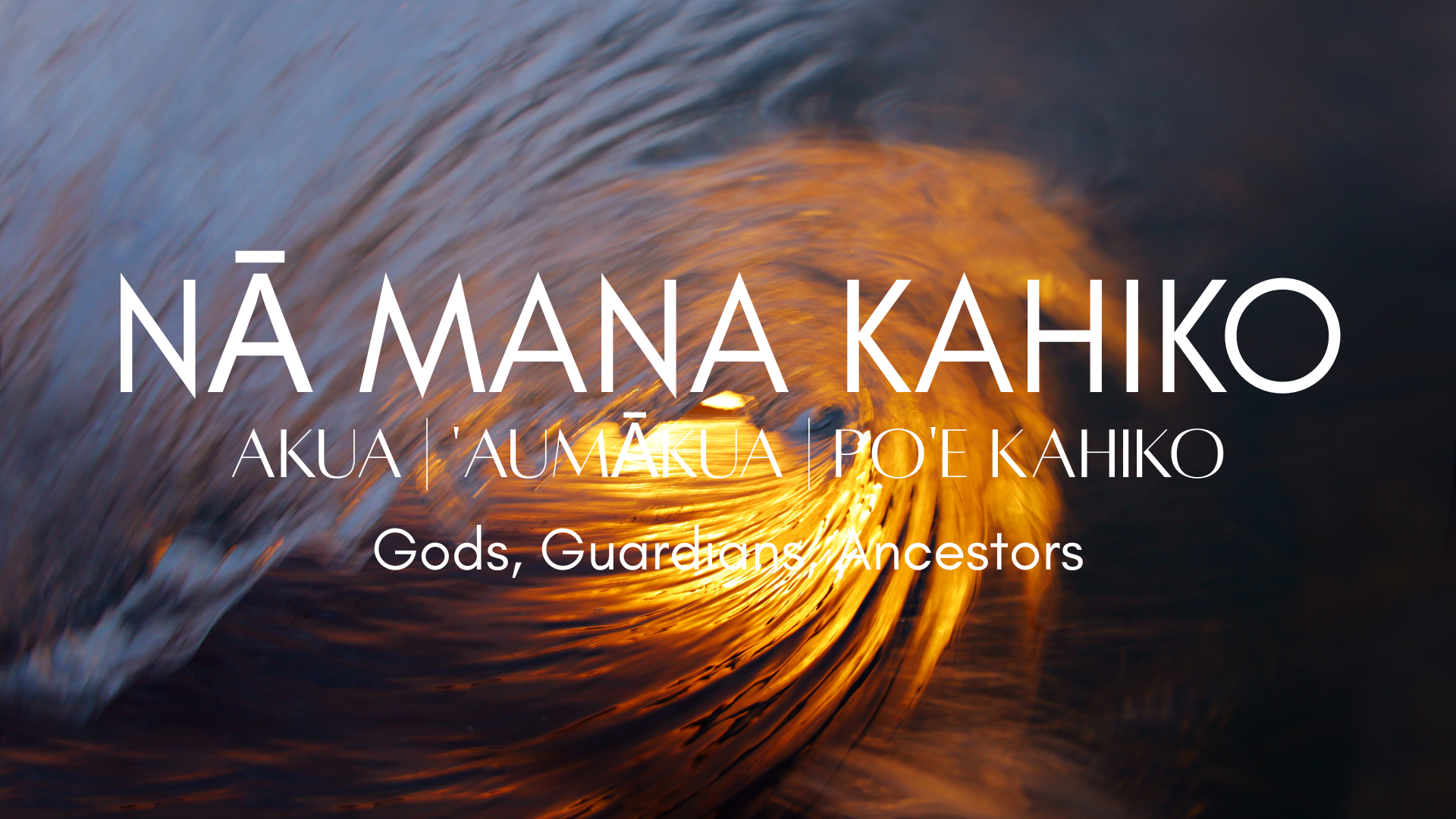
This is why I have created Nā Mana Kahiko. |
| | | |
| | |
HE KUHIKUHI
Direction
Why These Teachings Matter
There is a difference between knowing that our ancestors recognised gods, guardians, and ancestral relationships, and understanding how those relationships shaped the way they lived.
The first gives us information.
The second begins to give us a foundation from which we can understand Hawaiian practice.
Pule, Hoʻoponopono, Lomilomi, Hula, and the many expressions of Hawaiian life did not develop in isolation from these wider understandings.
They belonged to a world in which relationships carried responsibilities, knowledge was inherited and maintained, and human life was understood within a much larger order of existence.
My intention with Nā Mana Kahiko is to bring these teachings into a coherent body of study, so that those who enter can begin to understand the distinctions, relationships, and cultural foundations with greater clarity.
This is not a collection of stories offered simply for interest or entertainment.
It is an opportunity to study an important dimension of Hawaiian thought with the time and attention it deserves. |
| | | |
| | |
HE MOʻOMEHEU
Cultural Insight
NĀ MANA KAHIKO
A Three-Part Live Intensive with Kumu Kawika
13–15 November 2026 | Live Online
For three consecutive days in November, we will enter these understandings through teaching, moʻolelo, cultural knowledge, questions, and conversation.
Each intensive stands on its own, but together they offer a fuller understanding of the relationships between the powers of existence, ancestral guardianship, and the generations from which we descend.
FRIDAY, 13 NOVEMBER
NĀ AKUA — Gods & Goddesses
Who are the akua? How were they understood within Hawaiian life? What do their genealogies, stories, and relationships reveal about the world our ancestors inhabited?
We will explore the nature of the akua, their associations with the powers of existence, and the ways in which Hawaiian people understood and approached these relationships.
This is an opportunity to move beyond simply knowing the names of the gods and goddesses and begin understanding the cultural world to which they belong.
SATURDAY, 14 NOVEMBER
NĀ ʻAUMĀKUA — Ancestral Guardians
What distinguishes an ʻaumākua from an akua or an ancestor? How are ancestral guardians connected to families, genealogies, and inherited responsibilities?
We will examine the place of ʻaumākua within Hawaiian life, including the relationships of guidance, protection, care, and responsibility that may exist between families and their ancestral guardians.
This intensive will also address common misunderstandings that have emerged through modern interpretations of Hawaiian spirituality.
SUNDAY, 15 NOVEMBER
NĀ POʻE KAHIKO — Ancestors
What do we inherit from those who came before us?
Ancestry is more than a record of names and generations. It includes the knowledge, practices, responsibilities, and ways of living that have been carried forward through families and lineages.
In our final intensive, we will explore the place of the poʻe kahiko within Hawaiian understanding, and what it means to recognise the continuing responsibilities of inheritance and continuity.
Registration is now open.
EXPLORE NĀ MANA KAHIKO |
| | | |
| | |
Join Me for Nā Mana Kahiko
13–15 November 2026
Live online via Zoom
7:00–10:00 pm Sydney (AEDT)
9:00 am–12:00 noon Central Europe (CET)
Each intensive includes three hours together, with a break, teaching, moʻolelo, questions, and conversation.
You may register for one intensive that corresponds to your interests or enter the complete three-part series.
For those who want to understand these ancestral relationships as a connected body of teaching, I encourage you to attend all three. The series has been deliberately arranged so that each day builds upon the understandings established in the previous one.
Registration is now open.
EXPLORE NĀ MANA KAHIKO |
| | | |
| | |
A HUI HOU
Until We Meet Again
As I spend these days here on Molokaʻi, I am reminded again that the teachings we carry did not begin with us.
They were shaped by generations of people who observed the world, recognised their relationships within it, and carried forward understandings that continue to inform our lives today.
Nā Mana Kahiko is an opportunity for us to enter some of those understandings together.
Whether you are already studying within Mana O Kahiko, have participated in our gatherings, or are encountering these teachings for the first time, I welcome you to explore the series and consider which of these intensives you would like to enter.
I look forward to gathering with you in November.
A hui hou,
Kumu Kawika
Mana O Kahiko |
| | | |
|